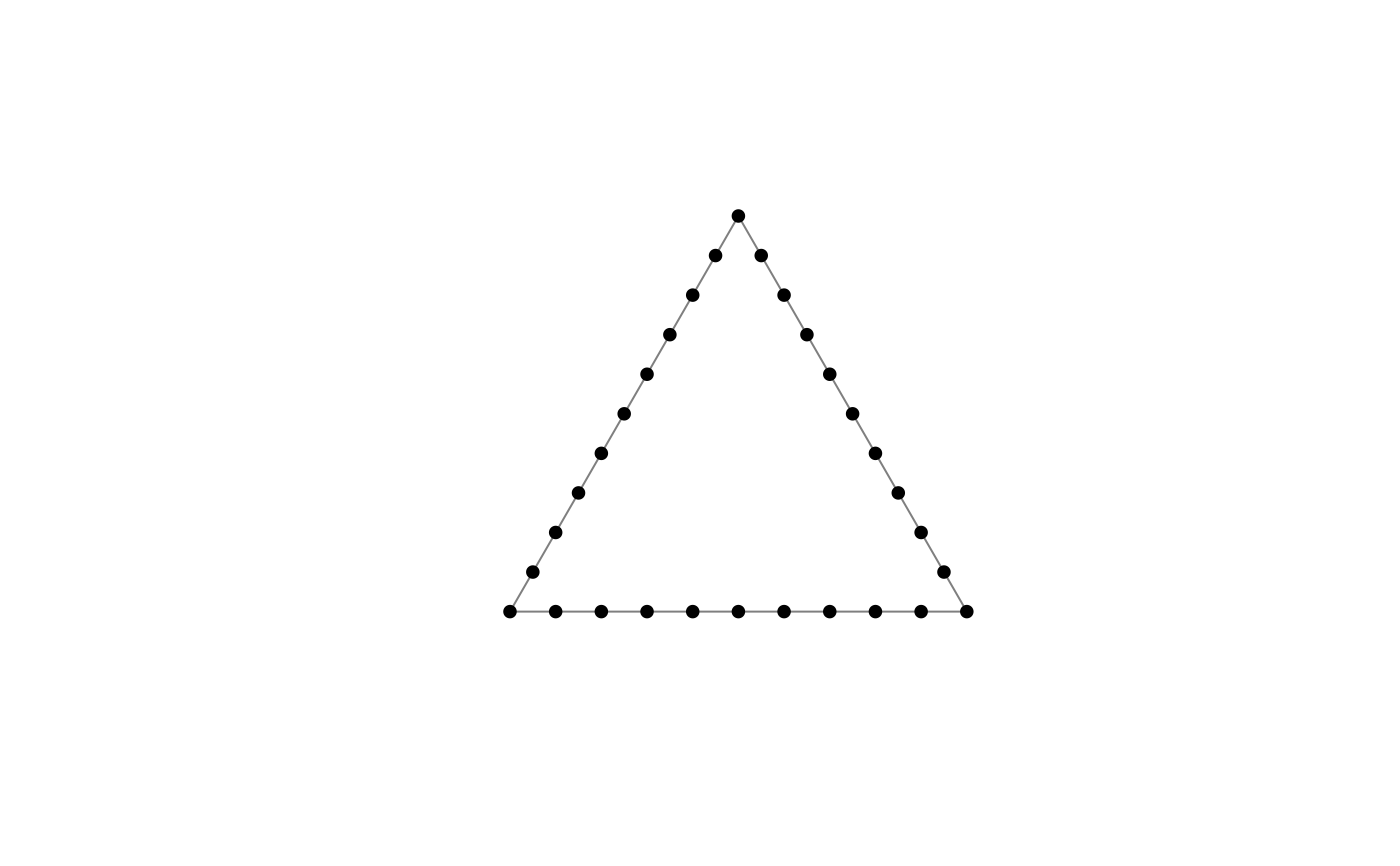
sttriangle() generates a string art pattern on the boundary of an
equilateral triangle. Pegs are distributed uniformly along the triangle
perimeter and connected using an additive modular rule.
Usage
sttriangle(
  n = 30,
  k = 7,
  col = "blue",
  lwd = 1,
  plot = TRUE,
  show_points = TRUE,
  show_labels = FALSE,
  verbose = FALSE,
  side = 2,
  rotate = 0,
  show_strings = TRUE,
  template = FALSE,
  point_col = "black",
  point_cex = 0.8,
  point_pch = 19,
  point_bg = "white",
  label_cex = 0.7,
  label_col = "black",
  border_col = "grey50",
  border_lwd = 1,
  bg = "white",
  main = NULL
)
Arguments
- n
Integer. Number of pegs placed along the triangle boundary. Must be at least 3.
- k
Integer. Additive modular step used in the connection rule. Must satisfy
1 <= k <= n - 1.- col
String color passed to
graphics::segments().- lwd
Positive number. Line width used to draw the strings.
- plot
Logical. If
TRUE, draws the figure.- show_points
Logical. If
TRUE, draws the pegs.- show_labels
Logical. If
TRUE, draws peg labels.- verbose
Logical. If
TRUE, prints a short audit to the console.- side
Positive number. Side length of the equilateral triangle.
- rotate
Numeric. Rotation angle in radians applied to the whole figure.
- show_strings
Logical. If
TRUE, draws the string connections.- template
Logical. If
TRUE, draws only the peg template, without string connections. This is equivalent to settingshow_strings = FALSEandshow_points = TRUE.- point_col
Peg color.
- point_cex
Positive number. Peg size.
- point_pch
Plotting symbol used for pegs.
- point_bg
Peg background color when applicable.
- label_cex
Positive number. Label size.
- label_col
Label color.
- border_col
Triangle border color.
- border_lwd
Positive number. Triangle border line width.
- bg
Plot background color.
- main
Optional plot title. If
NULL, no title is displayed.
Value
Invisibly returns a list of class stringart_result with:
- pegs
A
data.framewith columnsindex,x, andy.- connections
A
data.framewith columnsconnection_index,from,to,x_from,y_from,x_to,y_to, andlength.- total_length
Total string length.
- audit
A character vector with audit information.
- meta
A list with construction metadata, including the triangle vertices.
Details
The triangle is centered at the origin using its centroid. The pegs are placed uniformly along the perimeter in counterclockwise order.
The additive modular connection rule is:
to = ((from + k - 1) %% n) + 1.
When gcd(n, k) = 1, the modular rule forms a single cycle through all
pegs. When gcd(n, k) > 1, the construction decomposes into independent
cycles.
Examples
sttriangle()
 res <- sttriangle(plot = FALSE)
head(res$pegs)
#> index x y
#> 1 1 -1.0 -0.5773503
#> 2 2 -0.8 -0.5773503
#> 3 3 -0.6 -0.5773503
#> 4 4 -0.4 -0.5773503
#> 5 5 -0.2 -0.5773503
#> 6 6 0.0 -0.5773503
head(res$connections)
#> connection_index from to x_from y_from x_to y_to length
#> 1 1 1 8 -1.0 -0.5773503 0.4 -0.5773503 1.4000000
#> 2 2 2 9 -0.8 -0.5773503 0.6 -0.5773503 1.4000000
#> 3 3 3 10 -0.6 -0.5773503 0.8 -0.5773503 1.4000000
#> 4 4 4 11 -0.4 -0.5773503 1.0 -0.5773503 1.4000000
#> 5 5 5 12 -0.2 -0.5773503 0.9 -0.4041452 1.1135529
#> 6 6 6 13 0.0 -0.5773503 0.8 -0.2309401 0.8717798
res$total_length
#> [1] 33.03866
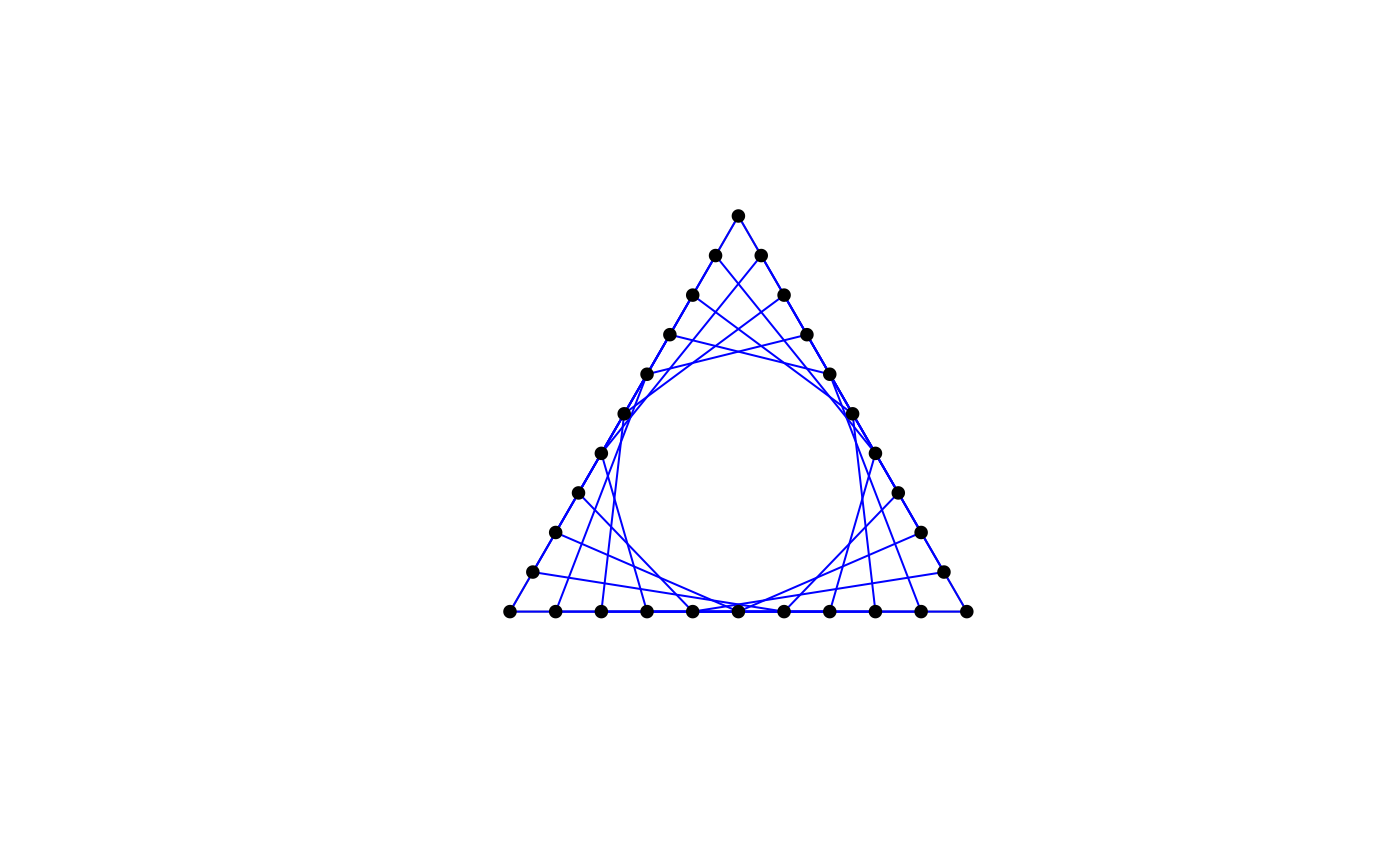
sttriangle(n = 30, k = 7, side = 2, col = "blue", lwd = 1)
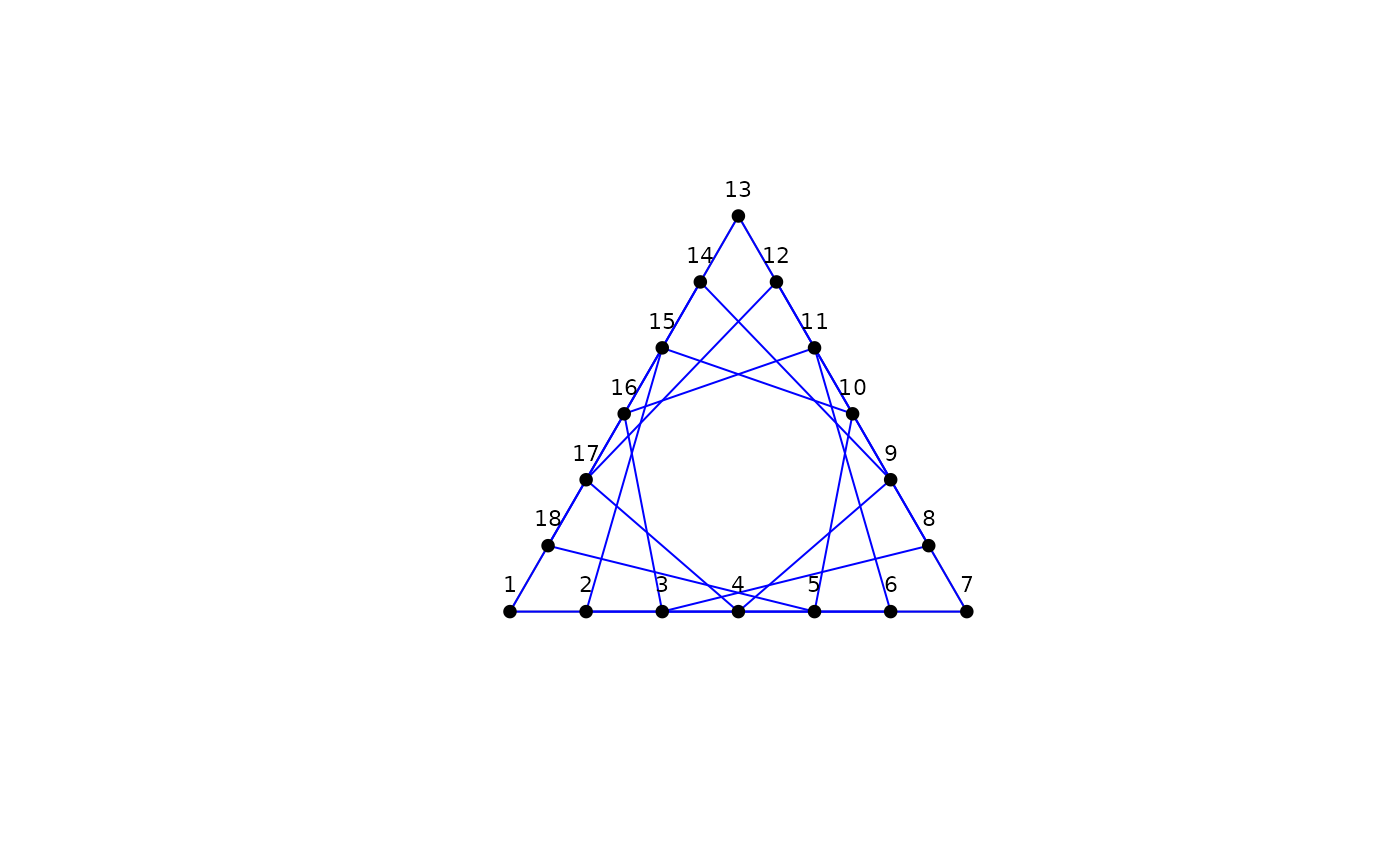
sttriangle(n = 18, k = 5, show_points = TRUE, show_labels = TRUE)
res <- sttriangle(plot = FALSE)
head(res$pegs)
#> index x y
#> 1 1 -1.0 -0.5773503
#> 2 2 -0.8 -0.5773503
#> 3 3 -0.6 -0.5773503
#> 4 4 -0.4 -0.5773503
#> 5 5 -0.2 -0.5773503
#> 6 6 0.0 -0.5773503
head(res$connections)
#> connection_index from to x_from y_from x_to y_to length
#> 1 1 1 8 -1.0 -0.5773503 0.4 -0.5773503 1.4000000
#> 2 2 2 9 -0.8 -0.5773503 0.6 -0.5773503 1.4000000
#> 3 3 3 10 -0.6 -0.5773503 0.8 -0.5773503 1.4000000
#> 4 4 4 11 -0.4 -0.5773503 1.0 -0.5773503 1.4000000
#> 5 5 5 12 -0.2 -0.5773503 0.9 -0.4041452 1.1135529
#> 6 6 6 13 0.0 -0.5773503 0.8 -0.2309401 0.8717798
res$total_length
#> [1] 33.03866
sttriangle(n = 30, k = 7, side = 2, col = "blue", lwd = 1)
sttriangle(n = 18, k = 5, show_points = TRUE, show_labels = TRUE)
 sttriangle(template = TRUE)